I know I'm in my own little world, but it's OK.
They know me here...

Translate

Showing posts with label author. Show all posts

Tuesday, November 12, 2013

GUEST AUTHOR: Maggie Mundy

Today I have Maggie Mundy, a fellow RWAustralia author - please make her feel welcome as she shares a post about her latest release, HIDDEN MORTALITY (now out with Soul Mate Publishing, October 2013).

Take it away, Rowena.

Maggie Mundy lives in Adelaide, Australia and is a member of Romance Writers of Australia, and the local chapter SARA (South Australian Romance Authors). She recently completed a Bachelor of Arts in Drama and English at Flinders University.

She had a short story published in the RWA Topaz Anthology Little Gems in 2010 called Sea and Vines. Over the past year she has had stories on line with Alfie dog in the UK and Antipodean SF in Australia. She has also performed for many years in corporate entertainment for which she wrote her own sketches which probably explains why her head is so full of characters.

She loves writing romance but thinks falling in love can be scary, especially in her stories where creatures of the night really exist.

As an introduction to a character from HIDDEN MORTALITY, today I'd like you to meet Seth the hero.


Name: Seth Scanlon.


Race: human.

Characteristics: At six foot five with a muscle-bound body and a shaved head one of the character in the novel describes him like Vin Diesel on a bad day. Of course they don’t know the demons he cares about his past.

Age: 35 for more than 200 years so far. When I stared to write this novel I always saw Seth as a combination of Kelly Slater and Vin Diesel. I have to admit I find them both yummy.


Background: Seth was born in the early 1800 in a small town called Trowbridge just outside of Bath where he trained with his father to be a blacksmith. He hated his father who was a drunk and beat his mother. She was found drowned in a local river and it was considered suicide. He swore he would never become like his father but he didn’t completely succeed.

His first true love Rosie was married when he met her. He was honourable and left her alone. When her husband died Seth was already in an unhappy marriage and starting to drink. His wife died in childbirth and Rosie was murdered. His life was spiralling out of control
.

Rosie was killed in a ritual that was said to provide immortality to the killers. She had witch blood and granted the gift of immortality to Seth as well. She asks him to protect her descendants and find the killers.

Two hundred and more years have passed and Seth still searches and watches over Rosie’s descendants. Recently his need to find Rosie’s killer has changed because he has fallen in love with her descendant Cara.

Interesting facts: Seth can only kill the other immortal who murdered Rosie with a dagger he fixed. He does not know the whereabouts of the dagger. When he kills the murderer he will die himself. That was fine with him until he met Cara.  Below you can see the cover for Hidden Mortality that will be out with Soul Mate Publishing in November. I actually like the fact that Seth’s face is not completely shown as it gives the reader the ability to fill in the rest of the details.

A witch is murdered in 1850 in a ritual that will grant longevity to four men. What they are not aware of is that she has bestowed the same power to another called Seth to avenge her death.
Cara lives in present day Bristol, and is a descendant of the witch. Having been unlucky in love she fills her days with food with her Irish themed catering business. Her nights are another matter; they are full of erotic dreams of a mysterious lover, or nightmares with mutilated bodies. So this wasn’t the best time for her Nana to tell her she is coming into her power.

Tuesday, April 30, 2013

CRAFT: Shifting Goals

The wonderful, incredibly knowledgeable, Paul Roe is my guest blogger for the next four weeks. She's written a fantastic series on craft techniques for writers (and it's not just aimed at romance writers!).

The Mid-Week Technique series - there are 8 posts as of Dec.2012 - are on her blog. I'll place a list of them with the last guest post, at the end of the month, for anyone who wants to read all of them (and I highly recommend you check them out as they're gems in terms of information and examples).

Without further ado, I'll let Paula begin her post...

Shifting Goals - by Paula Roe

Keep those awesome writing questions coming! Today’s query: “what to do when your character goals change mid-story?”

So, let’s talk about the two types of character goals: internal and external. The external is a tangible thing, a want that the character is pursuing at the start of the story. This can be a wife, money, status, boyfriend, a new job, an object, escape from a terrible relationship, etc. In my latest book, A Precious Inheritance, both my hero and heroine desperately want the unpublished manuscript of a deceased best selling author. In my first book, my hero needs answers to his past.

The internal goal is something deep inside that character – a need, a desire – that drives them to action. Your characters are more often than not, unaware of this internal goal – to them, it’s all about the external. Your hero is not going to stop and think “I need a wife to gain control of my father’s shares and in the process will fulfill a deep-seated need for love and loyalty I’ve been lacking.” :grin:

The internal is an emotional, unseen, driving force that enhances and feeds into their external goal. For example, your heroine may want to buy a home because deep down, she craves that sense of security and belonging that were lacking when she was growing up. I made a comprehensive list of goals (or wants) ages ago, so here they are:
  • Freedom
  • Adventure
  • Unconditional Love
  • Honour
  • Acceptance
  • Money/wealth
  • Family
  • Status quo
  • Status
  • Respect
  • Revenge
  • Justice
  • Power
  • Security/home
  • Knowledge
I have more on my Write a Novel in 3 months articles here and here.

The internal goals do not shift. That is the whole point of your character’s journey, their driving force that gets them from Chapter 1 to The End. Their internal goal has been formed and shaped throughout their lives, driving their choices.

What can change is their external goal. For example, a girl desperately wants to seduce her hot neighbor, so gets her male best friend to give her seduction techniques. At some point in the story, her external goal (the hot neighbor) changes to the best friend.

In one of my works-in-progress, my warrior hero’s external goal is to escape captivity to live a life in solitude. Of course, this goal changes after he meets the heroine and they have to battle together to overthrow the evil king. What doesn’t change is his internal goal, which is peace and acceptance.

The other thing to consider is WHY their external goal changes. Is it because your character’s beliefs have changed? Has something happened? Have they gotten new insight or new information into a previous situation or happening that prompts the change?

Changing your character’s external goal is not bad. It can enhance and enrich your story, provide plot twists and keep your reader hooked. But be aware of why it’s changing. As long as it is in keeping with your character’s core beliefs then go for it!

Many thanks to Paula Roe for being so willing to share her knowledge on the craft of writing and allowing me to post these articles on my blog.

For those interested, here's a complete list and links for Paula's Mid-Week Techniques series:

Author bio: Paula Roe is a bestselling, multi-published author with over a quarter of a million books sold world-wide. Her articles have appeared in writing journals, blogs and hard copy and she is a frequent speaker at conferences and local writing groups. 

Before publication, Paula's writing won and placed in various contests, including Wisconsin Romance Writers Fabulous Five Silver Quill, Magnolia State Dixie First Chapter, Romance Writers of Australia's Emerald Award and the Valerie Parv Award. When she's not writing, she's designing websites, conducting workshops and tutorials, cooking or building Lego.

Visit her at http://www.paularoe.com/

Tuesday, April 23, 2013

CRAFT: Where to Start Your Story

The wonderful, incredibly knowledgeable, Paul Roe is my guest blogger for the next four weeks. She's written a fantastic series on craft techniques for writers (and it's not just aimed at romance writers!).

The Mid-Week Technique series - there are 8 posts as of Dec.2012 - are on her blog. I'll place a list of them with the last guest post, at the end of the month, for anyone who wants to read all of them (and I highly recommend you check them out as they're gems in terms of information and examples).

Without further ado, I'll let Paula begin her post...

Where to Start Your Story - by Paula Roe 

How many of you answered “at the beginning – DUH!” ? :grin: 

Yes, it does seem obvious, doesn’t it? But just where do you determine the beginning? Where your main characters first meet? When your heroine wakes up?  When the killer is stalking his next victim?  Or when your hero is ruminating about this two-year old divorce? 

As a contest judge, I see so many entries that start in the wrong place. Definitely one, sometimes two chapters of slow, plodding narrative/introspection/description that really let a good story down. Now, short of me reading your stories and saying “ah-HA! Forget all that other stuff – here’s where you should start!” you’re going to figure it out yourselves.

So where do you start? At a point of major change.

Chris Vogler (he of the awesome The Writers Journey), Michael Hauge (he of the awesome Writing Screenplays That Sell) and various other writing legends (Robert McKee included) call it The Call To Adventure. It is your character’s ‘jolt’: some event or realization that shocks them out of their Ordinary World and shakes up their life. They have to make a choice when confronted by this call – if they can ignore it and go back to their normal lives without a backwards glance, then it is not a true call.

To elaborate and get you thinking, here’s an example:

Your heroine is about to walk into an interview for a new job. She’s sat in the reception area, thinking about how desperate she is for this job, how much this money would mean to her family, to her sick father who’s just finished another round of chemo and the bills are mounting up.

She wonders about her brother, who’s conveniently living overseas and unable to contribute. Her dead mother who was a saint when she was living and would hate to see her little girl now working 24/7 to support her father.

She ruminates about her last few low-paid jobs, her terrible bosses and wonders what this new one would be like to work for. She’s heard he’s demanding but fair – the same can’t be said for the man’s son who seems to be content spending his time surfing and partying.

Partying… she thinks briefly about last weekend, where she got to let her hair down for once, and ended up a little drunk and making out with the cute bartender in the parking lot.

This goes on for a page or two, until the office door finally opens and…. yep, the son aka cute bartender stands on the threshold.

So where would you start this story? Hands up who said “where the office door opens”?

Why? Because it’s our heroine’s Call to Adventure. She has a choice – either step up and go right on into that interview (aka Stepping Across the Threshold) or turn and leave. All that introspection, all that past stuff is past, and can be filtered in elsewhere.

You also don’t need pages upon pages of it because introspection tends to slow the pace – and you want your readers to jump right into your story at Chapter 1, not get bogged down with unimportant details.  A simple "She wanted this job. No, she needed it. More than she’d ever needed anything in her life." would suffice to show the reader her desire. Then you can sprinkle in the whys later, through dialogue, deep POV and introspection.

Alternatively, if you do start with your heroine sitting there, waiting for the interview, this can be a good opportunity to get some brief backstory across, enough to whet the reader’s appetite but not too much that will have them skimming the paragraphs. The key to this is smart editing: knowing when too much is overkill and just plain boring (see example above).

It’s important to note that in category romances, the sooner you can get your hero and heroine together at the start, the better. Why? Because it will throw your reader right into the story, as well as highlighting the conflict that will carry your story along. Of course, this isn’t a rule, but you only have a short word count so you have to make every. Word. Count.


Author bio: Paula Roe is a bestselling, multi-published author with over a quarter of a million books sold world-wide. Her articles have appeared in writing journals, blogs and hard copy and she is a frequent speaker at conferences and local writing groups. 

Before publication, Paula's writing won and placed in various contests, including Wisconsin Romance Writers Fabulous Five Silver Quill, Magnolia State Dixie First Chapter, Romance Writers of Australia's Emerald Award and the Valerie Parv Award. When she's not writing, she's designing websites, conducting workshops and tutorials, cooking or building Lego.

Visit her at http://www.paularoe.com/

Tuesday, April 16, 2013

CRAFT: Switching Point of View

The wonderful, incredibly knowledgeable, Paul Roe is my guest blogger for the next four weeks. She's written a fantastic series on craft techniques for writers (and it's not just aimed at romance writers!).

The Mid-Week Technique series - there are 8 posts as of Dec.2012 - are on her blog. I'll place a list of them with the last guest post, at the end of the month, for anyone who wants to read all of them (and I highly recommend you check them out as they're gems in terms of information and examples).

Without further ado, I'll let Paula begin her post...

Switching Point of View - by Paula Roe

Today I’m talking about point of view (POV). Stop me if you’ve heard any of these before:
  1. “You should only be in one character’s head per scene – no switching point of view.”
  2. “Readers don’t want to know what your hero is thinking -  it’s your heroine’s story, so tell it from her viewpoint.”
  3. “Whatever you do, don’t head hop!”
  4. “You should stick with just your hero and heroine’s POV.”
  5. “If you write first-person POV, your reader won’t empathise with your other characters.”
Now, while I’m not going to argue the pros and cons of these (sadly, all-too-real) statements, I will talk about effectively and smoothly switching from one character’s POV to the other.  And it is really, really simple.

Here’s a paragraph I prepared earlier:
Jenny gasped, the breath in her throat burning the way the whiskey had done only moments before.  Jason’s hand on her wrist tightened, fingers digging into her soft tender flesh and her anger flashed behind bright blue eyes.  He smiled, knowing he was affecting her, judging by the way her pulse leaped under his fingers.

Gosh, it’s actually painful  to leave that badly written paragraph intact :angry: !  Argghh!!  So, what do we know about this para?

Sentence 1 – we’re in Jenny’s POV.  Why?  Because of ‘the breath in her throat burning’.  This is something she feels, that no-one else can.
Sentence 2 – we start out in Jenny’s POV (his hand on her wrist tightened) but end up in Jason’s because of the ‘anger flashed behind her bright blue eyes’.  Because she can’t see her anger, and she wouldn’t think ‘my bright blue eyes’.
Sentence 3 – In his POV, because he feels her pulse beneath his fingers.

So how to fix it?  Before I do that, here’s some important things about POV switches:
  1. not every POV switch should start with an extra line space – in fact, if you do this in the same scene, it will only jar your reader, because ‘extra space’ means ‘later on’ or ‘this is a new scene’.  Yes, some publishers do it and it annoys the hell out of me!
  2. too many POVs in one scene and you start to lose the tension of the moment, plus annoy and possibly confuse your reader
  3. an effective way to start a new POV is with a new paragraph, and the character’s name, followed by something only they would know/think/feel
So, rewriting the above sentences (plus making our hero a little less like a violent jerk…):
Jenny gasped, the breath in her throat burning the way the whiskey had done only moments before.  When his
Jason’shand on her wrist tightened,
fingers digging into her tender flesh, and heranger
flashed behind bright blue eyessurged, giving her enough strength to break his possessive grip.
“Don’t touch me!”
“That’s not what you were saying last night.”
Jason
Hesmiled and let her put distance between them, even though his entire body ached to get up and personal with that luscious mouth of hers.  A now-scowling mouth that had only been too willing to open up for him last night.  He sure as hell knew he affected her too, 
knowing he was affecting her,judging by
herthose flashing blue eyes and her leaping pulse he’d briefly held
leapedunder his fingers.

Somewhat better :smile:

So to reiterate: when you are in one person’s head, use words and thoughts that they would say and feel, and describe stuff via their eyes. 

Easy Way to Count your POV Switches
Use either the highlighter option in Word, or do a printout and use highlighter pens (I do blue for my hero, pink for my heroine).  So when you spread your scene out across your table or floor, you have a visual representation. 

But how many switches is too much?
Well, I can’t answer that for you.  But I can tell you I had to rework one scene in my last book because I was all over the place with those switches.  It started off in his POV, then went to hers, then back to his on the same page, then back to hers, then his>hers again.  Gave me whiplash!

I’ve heard writers say “think about who has the most to lose in the scene and write it from their POV” but honestly, this is a bit hit and miss for me.  I work out whose head I’m going to start in based on a) how I ended the prior chapter or scene, plus b) what the reader needs to know about this character right now in the story.

My rough draft will be riddled with way too many POV switches and it really only takes minor editing (after I highlight my scene) to cut those jumps.  And sometimes that information in that character’s head can be best used in another scene, at another time.


Author bio: Paula Roe is a bestselling, multi-published author with over a quarter of a million books sold world-wide. Her articles have appeared in writing journals, blogs and hard copy and she is a frequent speaker at conferences and local writing groups. 

Before publication, Paula's writing won and placed in various contests, including Wisconsin Romance Writers Fabulous Five Silver Quill, Magnolia State Dixie First Chapter, Romance Writers of Australia's Emerald Award and the Valerie Parv Award. When she's not writing, she's designing websites, conducting workshops and tutorials, cooking or building Lego.

Visit her at http://www.paularoe.com/

Tuesday, April 9, 2013

CRAFT: Nine Points of Trust

The wonderful, incredibly knowledgeable, Paul Roe is my guest blogger for the next four weeks. She's written a fantastic series on craft techniques for writers (and it's not just aimed at romance writers!).

The Mid-Week Technique series - there are 8 posts as of Dec.2012 - are on her blog. I'll place a list of them with the last guest post, at the end of the month, for anyone who wants to read all of them (and I highly recommend you check them out as they're gems in terms of information and examples).

Without further ado, I'll let Paula begin her post...

NINE POINTS OF TRUST - by Paula Roe
So here we go – my first topic.  I actually came across this issue as I was writing my seventh book (A Precious Inheritance, part of Desire’s exciting Highest Bidder continuity), and after I handed it in, wondered if other writers had the same issue.  Mainly, the two main characters (in my case, my hero and heroine) start off at the beginning of the story disliking and mistrusting each other, and over the course of the book, they end up trusting, then loving, to reach their happy-ever-after.  But just how do you practically write about that?  How do you show that gradual change of mind – in actual words on the page – that will be convincing to your reader?

This analysis warranted going to the movies, plus my trusty index cards, and I think I managed to pin down Nine Points of Trust.  For ease of writing, I have made the heroine the distrustful one, but this can go both ways.  Plus, for a point of reference, I’ll use one of my favorite movies – I, Robot  (featuring the fabbo Will Smith) – as an example.  So here we go.

1. MISTRUST (internal emotion)
Mistrust is formed either through direct deeds of your character or via others’ deeds.  This creates conflict within your character and arouses strong emotions.  Reasons for this mistrust can include:
  • opposites from different walks of life
  • he stands for something she hates (and vice versa)
  • opposing goals (she wants something and he stands in her way)
  • bad deeds done (e.g. he’s destroyed her father’s livelihood)
  • bad family (tainted by association)
  • tainted past
  • different beliefs
At this stage, there can be attraction or not, and your character can either acknowledge that or not. e .g. “Sure, he was gorgeous, but he also represented ten years of oppression and ridicule.”

2. REITERATING MISTRUST (external/internal)
  • This can happen through observation, an event or dialogue.  Your character observes, or is told/reads about events that seem to reiterate their mistrust.
3. 1ST SEED PLANTED LEADING TO FIRST DOUBT (external/internal)
  • Something happens that the character either witnesses or experiences first hand that plants the first seed of doubt
  • The hero may be compared to another character in a scene, and the other character comes off worse.  For e.g. the way your hero treats servants, waiters, colleagues and the less fortunate will say a lot about his character.  If you have a scene where your heroine can see him interacting with others in a positive light, this will cast that shadow of doubt. Chivalry, politeness, courtesy are all good qualities in a hero.
  • Your character knows there’s something ‘not right’, but cannot put their finger on it.  The ‘not rightness’ can be acknowledged as attraction.  The body thinks ‘attraction’, but the head can think ‘just another reason not to trust him.’
  • At this point, if your heroine’s mistrust is founded, she can walk away from the situation with no qualms.  She is not emotionally invested.
4. OUTSIDE INFLUENCES CREATE STRONGER DOUBT (external/internal)
  • Your heroine is getting a stronger impression of who your hero really is, which clashes with her beliefs
  • Other people/events occur to create a stronger comparison.  This can happen via family, friends, work, exes and/or events in which they’re thrown together
  • Remember, others may also have a stake in the heroine’s mistrust of your hero, too
5. 2ND SEED PLANTED – EMPATHY AND TENTATIVE TRUST (internal/external)
  • This is a coming together of goals – familiar traits/past/events are shared and a sort of ‘kindred spirit’ is formed
  • The hero could inadvertently help the heroine with a problem here, or stick up for someone who is close to her
  • At this stage, it would create emotional impact if her trust was misplaced now
6. OPENING OF THE MIND (internal)
  • Big step forward, where the heroine must make a choice of opening her mind to the possibility that her impression is wrong
  • She may take stock of past events to ensure she’s doing the right thing
7. 3RD SEED PLANTED – MAJOR EVENT (external event)
  • Heroine is now committed.  If mistrust is founded now, she will be emotionally affected
  • She realizes the hero is not a bad guy, she may even rationalize and think through some of the prior ‘bad deeds’ and come up with a healthier scenario
  • At this stage, she can also sway either way ==> there can be another event where she places even more trust in the hero OR something could happen that makes it impossible for her to reconcile the guy she’s come to know with the guy she thought she knew.  She knows in her heart that he’s a good guy
8. BLACK MOMENT AND REVELATION ***

  • Major point where all trust appears to be unfounded – it’s her worst fear realized
  • This is plot driven, and goes back to your initial story question that sets up the plot of the book – e.g. will they solve the mystery/fall in love/find the killer?
*** Depending on your story, Point 8 may not be needed.  Why not?  Well, sometimes (in short category, especially) it could be a bit of overkill: you’ve spent all those pages getting from distrust to trust, taking your readers on that journey and now something happens to seemingly blow it all out of the water.  I’m not saying it never works, but it could throw the story prior to that point into disarray.  For e.g. if the heroine can believe the hero is still the awful person she thought at the start of the book from one action/misunderstanding/revelation, then what was the point of the journey?

Of course it’s up to you, the writer, to make the point :smile:   I do have one moment in  book # 7 where the hero thinks the heroine is behind something illegal but after he thinks it through, realizes that’s a stupid thing to think.  Then he consequently beats himself up about it, believing he doesn’t deserve her if he can automatically doubt her integrity.  It’s not a chapter or a long scene, rather a few paragraphs, but it was a logical thought for this character, so I kept this step.

9. TRUST
  • Your character is now totally convinced of the others’ integrity.  This doesn’t mean they are blind to flaws
  • She knows the hero is a good person – this may involve some verbal communication, an apology or talking over their previous mistrust
  • They can see behind the mask to accept them, flaws and all
At this total point of trust, it doesn’t mean that’s the end of your story.  You will also have to tie up loose ends in your plot/secondary characters/backstory/character goals etc.  But it does mean that your characters will be working together for a common goal.

Now, on to the practical application of I, Robot.  The interesting thing here is that some points are actually grouped together and are in a different order.  Lemme show you:

Gratuitous shirtless shot of Will Smith
I, ROBOT
Susan Calvin is a driven scientist dedicating her entire career to building and integrating robots into human society.  She is logical, clever and literal, and also appears to be lacking in humor.

Detective Del Spooner is a cocky charmer, hates robots and suspects one of killing the co-founder of United States Robotics, Dr Lanning, even though his death was deemed a suicide.

TOTAL DISTRUST
  • Dr Calvin is assigned to show Spooner around the USR building to complete his investigation.  His charm and flippancy clashes with her literal, scientific mind right away.  Then Spooner suspects a USR robot of killing Dr Lanning but Calvin is convinced the Three Laws (that govern all robots and protect all humans) are perfect ergo, a robot killing a human is impossible.  When Spooner shoots Sonny (the robot hiding in Dr Lanning’s office) Calvin’s mistrust is reiterated.  Then when Spooner starts shooting other robots to draw out Sonny (“they’re just lights and clockwork”), it just cements her mistrust
  • Spooner is determined to prove Sonny is the killer.  Calvin is adamant a robot cannot kill and believes Spooner to be irrational
REINFORCING DISTRUST
  • After a malfunction with a demolition bot at Lanning’s house, Spooner goes to see Calvin, but she refuses to believe his ‘killer robot’ theory, rather she says he has a ‘vendetta’.  They argue and Spooner says she likes robots because they’re cold and emotional.  She says it’s because they are safe and can’t hurt you.
SEED OF DOUBT PLANTED
  • When Spooner leaves, he hands her a photo of Calvin and the Doctor that he recovered in Dr Lanning’s house, and says “the problem is, I care.”  She chokes back tears and realizes Lanning meant something to him, too.
OUTSIDE INFLUENCES (leads to) ==> OPENING OF THE MIND
  • Calvin discovers Sonny is a completely new version of robot, one that has no USR uplink and can override the Three Laws if he so chooses.  He is unique.  He appears to have feelings and dreams, which throws doubt on everything she believes.
2ND SEED PLANTED – EMPATHY AND TENTATIVE TRUST and 3RD SEED – MAJOR EVENT
  • She hears Spooner has been in a car accident and goes to him to tell him about Sonny
  • When Calvin notices Spooner’s scars he finally tells her Dr Lanning gave him a robotic arm and lung after a horrific car accident, and also reveals a robot saved his life but not the girl’s in the next car.  The robot had analysed the survival probability and deemed his life to be the logical choice.  Spooner says a human would have saved her, thereby revealing his deep emotional mistrust of robots.
  • Calvin and Spooner go to the lab to talk to Sonny, where more clues are revealed.  Spooner calls Sonny “someone” instead of “something”, thereby increasing Calvin’s trust.
BETRAYAL
  • When they’re both discovered in the lab, Calvin’s boss tells her Spooner was suspended from duty, which shocks her.  Then her boss plays on her commitment and passion for robotics and convinces her Sonny must be terminated for the good of the robotics program and USR’s reputation.  Spooner believes she’s betrayed Sonny and is not interested in getting to the truth: “Somebody gets out of line around here and you just kill them.”
TOTAL TRUST
  • Spooner follows the clues on his own.  He leaves a message on Calvin’s phone, saying the old robots (who would have protected humans) are being destroyed by the new ones, but her personal robot intercepts the call.  Calvin witnesses her robot’s deception and suddenly realizes a) Spooner was right all along and b) she’s trapped in her apartment with a possible killer robot.
  • Spooner rescues Calvin.  She tells him she couldn’t kill Sonny – he is too unique – and they both sneak into USR to get to the bottom of who’s controlling the robots
Now, I realize these points are not gospel :grin:   There could possibly be flaws and things I’ve omitted, but hey, that’s the beauty of discovering a different writing method, right?   Love to hear your thoughts!


Author bio: Paula Roe is a bestselling, multi-published author with over a quarter of a million books sold world-wide. Her articles have appeared in writing journals, blogs and hard copy and she is a frequent speaker at conferences and local writing groups. 

Before publication, Paula's writing won and placed in various contests, including Wisconsin Romance Writers Fabulous Five Silver Quill, Magnolia State Dixie First Chapter, Romance Writers of Australia's Emerald Award and the Valerie Parv Award. When she's not writing, she's designing websites, conducting workshops and tutorials, cooking or building Lego.

Tuesday, February 26, 2013

TOPIC: World-Building with Pamela Palmer

As a reader have you ever wondered how paranormal authors go about building the worlds their characters inhabit? Or are you a paranormal romance author looking for hints on how to world-build?

Come join some of the paranormal romance world's best known authors and learn from them how they do it!

Today, I have Pamela Palmer as my guest!

Where do you start with your world-building - the world or the characters - and how do you develop your ideas?
Each of my series/worlds has started a little differently. My Esri series came about from a Bk#1 was reading titled Scottish Fairy Beliefs. It said that as recently as a couple hundred years ago there were learned men and women who still fully believed man-sized fairies/elves were to blame for much of the evils that befell people.

I got to thinking…what if they were right? What if there were such creatures in this world at one time, but there aren’t any more? And what if they found a way back? In Bk#1, The Dark Gate, an evil elf, an Esri, finds his way into modern day Washington, D.C. and soon all of human civilization is in danger.

My Feral Warriors series was sparked from a single scene idea. A woman finds a large, handsome stranger in her kitchen—a male who claims she’s not only immortal, but the savior of his race. From there, my imagination began spinning. Who was he? What was he? Eventually, I realized he was a shape-shifter, one of the last nine left in the world. This became one of the first scenes in Feral Warriors Bk#1, Desire Untamed.

Feral Warriors Series
My Vamp City series was sparked by a concept—a vampire otherworld connected to our own. The vampires can travel back and forth at will, but not their human captives or enemies. From there I had to figure out everything else, including where this vampire otherworld was located. When I realized it shared space with Washington, D.C. and would be Washington, V.C., Vamp City, I knew I’d hit on the story I wanted to tell.

Keeping track of details in series seems like a good idea given the complexity and/or length of some series. I like to use a series bible but what notes or methods do you use to ensure continuity and clarity of the nitty gritty?
I’m a very logical person who has no trouble whatsoever organizing my time, my day, my life. But when it comes to organizing stuff, including facts, files, etc., I’m hopeless. I can think of seven different places to file something…anything…and when I go to retrieve it, I’ll come up with seven more. When I put things away, whether in my house or on my computer, I often fear I’ll never see them again.

When I started Vamp City Bk#2, I forced myself to take the time to create a bible. And it’s wonderful! But I’ve never done that for the Feral Warrior series and I regret that every time I start a new book.

At first, I re-read the previous books before I started working on each new one, but I’m a slow reader and as the series has grown (I’m now working on book 8), that task has become increasingly unwieldy.

One thing I have done is taken the time to highlight key facts in each of the books, especially those throwaway facts that come back to bite me later because they weren’t important at the time and I forgot I ever mentioned them. But, for the most part, it’s all in my head. I WILL put together a Feral bible one of these days. Eventually.

Which of your series have been the most challenging to world-build? Have you struck any interesting problems while researching/developing your series?
I’d have to say the Vamp City series has been the most challenging, or perhaps just the most interesting since it’s set in a place that actually existed and does no longer…1870 Washington, D.C. Vamp City is a doppleganger of the Nation’s Capital created in 1870 by a powerful sorcerer, then handed over to the vampires. A land where the sun never shines.

Imagining this place was incredibly interesting. Not only did I have to thoroughly research the D.C. it was created from (a city with dirt streets, a half-built Washington Monument, and acre upon acre of rolling countryside), but I had to imagine what it would have become after 140 years of vampire occupation and neglect. And no sun.

I decided that no sun meant no plants, no trees, etc. In fact, I decided that the doppleganger world would have no living things at all except those intentionally brought in by the vampires—horse and humans.

Then, as I was finishing up Bk#1, A Blood Seduction, I saw the cover art and there were all these wonderful, spooky trees. (Cover artists rarely get a chance to read the books before they create the covers. Usually, we’re still writing them!) And since I still had the ability to change things, I did. I added trees to Vamp City. Lots and lots of dead trees.

Vamp City Series
Most of your series have woven paranormal aspects into a contemporary setting. Is there a sub-genre (ie. post-apocalyptic, sci-fi, fantasy) you haven't tried but would like to develop into a new series?
At this point, no. I like the urban fantasy take on the paranormal—basing my stories in our world. As a reader, I prefer this. I find it far easier to enter a story when the world is familiar. And, ultimately, I write what I want to read.

Pamela, thanks so much for sharing your insights into world-building. It's been wonderful having you here today!

For any reader who's already her fan, Pamela's next releases are available February & June 2013:


Reading order of Pamela's book list:

The Feral Warriors
Desire Untamed
Avon, June 30, 2009

Obsession Untamed
Avon, July 28, 2009

Passion Untamed
Avon, August 25, 2009

Rapture Untamed
Avon, June 29, 2010

Hunger Untamed
Avon, February 22, 2011

Ecstasy Untamed
Avon, October 25, 2011

A Love Untamed
Avon, December 26, 2012


The Vamp City Series
A Blood Seduction
Avon, May 29, 2012


The Esri Series
The Esri Series
The Dark Gate
Silhouette Nocturne, April 2007

Dark Deceiver
Silhouette Nocturne, July 2008

A Warrior's Desire
Harlequin Nocturne , January 24, 2012

Warrior Rising
Harlequin Nocturne , March 20, 2012


Novellas
Hearts Untamed
Avon, September 18, 2012

You can follow Pamela on Twitter, or sign up for her newsletter here.

Tuesday, February 12, 2013

TOPIC: World-Building with Larissa Ione

As a reader have you ever wondered how paranormal authors go about building the worlds their characters inhabit? Or are you a paranormal romance author looking for hints on how to world-build?

Come join some of the paranormal romance world's best known authors and learn from them how they do it!

Today, I have Larissa Ione as my guest!

Where do you start with your world-building - the world or the characters - and how do you develop your ideas?
It really depends on the series. For the Sydney Croft books and the Lords of Deliverance series, the characters came first and the world developed from there.

With the Demonica series, the world came first, since the idea was initially for an underworld hospital run by vampires, werecreatures and demons. I've got a new vampire series coming out next year as well, and that one also came from the world first -- an alternate reality in which vampires are enslaved. 


Keeping track of details in series seems like a good idea given the complexity and/or length of some series. I like to use a series bible but what notes or methods do you use to ensure continuity and clarity of the nitty gritty?
Honestly, a lot of it is in my head. It's getting to the point though, with the Demonica/LOD series, that I need to re-read all the books and take notes, because some of the older details are a little fuzzy in my head.

I do try to keep track of characters and plots by transferring main files from one project to another, which is easy through the Scrivener writing program I use. I'd DIE without that! I'll never use Word again.

I highly, HIGHLY recommend using Scrivener or WriteWayPro to write in, especially for anyone writing a series, because it's so easy to keep track of details. Plus, the manuscripts convert easily to Word so you can send to your editor.

Which of your series have been the most challenging to world-build? Have you struck any interesting problems while researching/developing your series?
The Lords of Deliverance series has definitely been the most challenging, in part because it's a spinoff of the Demonica series, but it's SO closely intertwined that it's been hard to hit the right balance of weaving in the old characters with the new ones.

It's also been a challenge to introduce all the new mythology without overwhelming the reader. I'd say that my most interesting problems have come from trying to convince today's modern readers to like characters who are from a completely different world and who don't share the same morals, societal boundaries, and religious beliefs.

It's been REALLY hard to do this, because honestly, I think my characters should be a lot more hard-edged than they are. These are people who have had to do heinous things to survive -- or to save the world.

Regan is one of those who had to make a hard choice to save every man, woman, and child on the planet -- and I lost a lot of readers (and got a lot of hateful mail and comments) over my decision to have her make that choice.

In the real world we have undercover agents, military special forces, spies, etc., who do unspeakable things to keep us all safe, but I'd say most people don't want to know about it. They'd rather close their eyes and let someone else make those choices.

Regan is one who made those choices, and sure enough, a lot of readers hated it. I think that's been my biggest problem with this series -- making characters realistic while keeping enough fantasy in them so readers don't hate them.

Most of your series have woven paranormal aspects into a contemporary setting. Is there a sub-genre (ie. post-apocalyptic, sci-fi, fantasy) you haven't tried but would like to develop into a new series?
I've love to write a post-apocalyptic zombie YA! I've got an idea, but it won't happen for a while. I've got too much going on with my current paranormals. I also plan on writing a Star Trek book, but that's also a ways away!

Thanks so much for having me, Kylie!


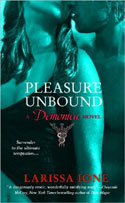
Larissa's latest release (from the Lords of Deliverance series):

t
Jillian Cardiff came to this remote mountain town to forget the demon attack that almost killed her. Instead, she rescues-and falls for-a gorgeous stranger who has no memory of anything other than his name. Handsome, charming, and protective, Reseph seems like the kind of man whom Jillian can trust. But with hints of a troubling history of his own, he's also the kind of man who can be very dangerous . . .
Reseph may not know why he mysteriously appeared in Jillian's life, but he knows he wants to stay. Yet when Jillian's neighbors are killed, and demon hunters arrive on the scene, Reseph fears that he's putting Jillian in danger. And once it's revealed that Reseph is also Pestilence, the Horseman responsible for ravaging the world, he and Jillian must face the greatest challenge of all: Can they forget the horrors of a chilling past to save the future they both desire?
Read excerpt here.

You can find out more about Larissa's books here, or follow her on Facebook, Twitter or Pinterst.

Tuesday, December 4, 2012

TOPIC: Character Motivation

Today, I have a guest blogger - Cassandra Shaw. She's talking about digging deep to find the layers to your character's motivations.

Dig Deep - finding your character's layers for their motivation.
When writing a story, long, short or epic our characters have to have motivation for the way the act, react and why we as writers portray them that way.

We might never share all the motivations with our readers but we the writer should know our characters intimately.

In our characters story arc we might want them to go from cold and remote to someone who is protective and loving –maybe to only our heroine, to his kid he discovered he had, to the his old army mate who he thought was dead.  The arc could be something simple like he’s a cop and he doesn’t trust another agency to share information yet by the end of the book he is working for that agency.
  • But then why was he cold and remote?
  • Why didn’t he trust that agency?
If we as writers don’t really understand the driving force of our characters personality than we can’t portray them accurately or with depth to our readers.

We probably don’t need to know he prefers white soap to blue. Or that he busted Toby Jacobs nose in fourth grade – unless Toby is in the story.  What we need, desperately need to know is what events, catastrophe, or life situation caused/created our character to be the way we need to portray at the beginning of our story arc.

He doesn’t trust woman / she doesn’t trust men.  This is not enough, you must dig deeper.

So let’s get the shovel out, scrape back the turf and start to find what created this trust issue. But remember in soil there are layers. Turf, top soil, sub-soil etc. We should examine each layer of what create our character. 
image thanks to http://en.wikipedia.org/wiki/Soil
At the very top we have the layer we all see

 – turf & plants or the bare surface.  – the O Horizon.
Dig deeper and we have Horizon A – Top Soil
Deeper Horizon  – B Sub soil
Horizon C – Regolith
Horizon R - Bedrock


Each soil layer listed above represents what made our character act and react the way they do today—in our story.  We cannot make them distrust men or women if they’ve had a great childhood, wonderful past partners and life has been like a Brady Bunch set. 

To be:
·                 Distrustful
·                 Cynical
·                 Prejudiced
·                 Angry
·                 Condescending
·                 Cruel
 Our characters have to have reason.

So let’s find the reasons behind the racist, cynical, angry man I’m going to describe below. 

Layer 1: The plants – is what we see on the surface
·       A man who holds himself aloof.
·       The woman who has no trust in men but has many female friends.  T
·       The hero who feels he must protect but can’t bond with anyone etc.
So let’s pick a scenario  - a character type that is popular in romance -  the hard bitten hero who doesn’t easily trust. He’s a good detective and feels the needs to protect innocents. We’ll call our hero Mike.
We’ll make him distrust wealth, lawyers and he is slightly racist about Asian’s.

Why is this:

Layer 2:  Stick the shovel in – find Horizion 0 – The humus. 
This is not very deep but we might see Mike has one good buddy who he watches sports, kills a beer, shoots pool with, but doesn’t share his personal life or inner thoughts.  So we know Mike can connect on some level, just not in an open manner.  He dates women but mostly for sex as he isn’t interested in them as partners nor does he like them much. His main frustration / hate in life are lawyers. Lawyers find ways of releasing the people he arrested on a technicality even though the person committed the crime.  He hates wealthy people who use their money to get free almost as much.

Layer 3: Put your boot harder onto the steel blade of the shovel and press and we expose Horizon A – the Top Soil.
This could be where we find Mike’s past relationships with women.  Top soil is usually the main plant growth matter but if here we discover Mike’s first two (and only) girlfriends left him. Girlfriend A, ran off with a football player in college because he was signed onto a team and she smelt money.  Girlfriend B, because Mike stopped studying law  (he distrusts lawyers and although his father wants him to be one he doesn’t want to live that lie) dropped out of college and joined the police force.  A & B, confirm women only want successful men with the potential to earn big $$$.

Layer 4: By this time you’ve got to Horizon B – the Subsoil.
Here we could find how he was treated in high school.  Perhaps Mike was tall and gangly, bright and geeky and really uncool ---- or he could even have him as the high school football captain but because of the next layers below - he is an angry kid who no one really likes.
I’m making Mike that kid. The angry kid. He’s good looking and the girls like him but because he is angry (see reasons in lower layers) he treats them like dirt for liking him, they dump him for the other boys.  Only the girls have chosen boys who are getting better grades and have richer families etc. He also notes that the boys with money are more popular than the poor ones.  So he sees money / prestige diggers.

Layer 5: Horizon C – Regolith.  
We’re getting into his family life here and we discover he has no women in his life and his dad’s a heartbroken man who never got over Mike’s mother.  Mikes dad dates rarely, hires the odd hooker for sex and never brings women home. Although he is a cop, Mike’s father has a drinking problem which leaves them poor and his dad with bad hangovers that leave him cranky. He doesn’t beat Mike but is verbally abusive.  Mike has grown up without female companionship so he sees / thinks they are for nothing more than sex, will break your heart and destroy you emotionally.

Layer 6:  Horizon R – Bedrock.  The deepest roots only go here.
And it’s here for Mike where it all started.  Mike’s mother packed her bags and left when he was six years old.  She never said goodbye to either male in her life.  Her note was brief. I need more, don’t look for me. After Mike’s father (who is a cop and who loves his wife desperately) does some investigating he discovers his wife ran off with one of the town’s Lawyers. A wealthy Asian Lawyer.  So for Mike, not only did she remove her love and the security a mother provides, she left his dad for someone with more money and prestige.

No all our hero’s will need for us to dig until we get to bedrock but some will.  Mikes reasoning could be the college girlfriends.  Have him love them and propose, they dump him for money etc.

My scenario gives me a chance to show a hero who has trust issues that run all the way to bedrock in his personality. He feels he can’t love a woman, thinks woman are only for sex, can’t connect with anyone around him, dislikes Asians and lawyers and he has wealth issues. 
I only need to make my heroine part Asian, a lawyer from old money and there is my conflict and my hero’s motivation not to trust her and fall in love.

But the truth is in this scenario the core motivation is trust – Mike doesn’t trust women on any level. And that will be the guiding motivation throughout the character Arc for Mike. Everything my heroine does, how she reacts to things, or says, Mike will consider with distrust.  

Give your characters deep reason for their actions – for Mike I wanted to show you how he had deep seated trust issues.

So get to know your characters and share it in small droplets as backstory in your manuscript.

What are the key motivators for your characters in your latest WIP??


Cassandra Shaw
Born a dreamer I've spend half my life staring out windows living an alternate fanciful life that exists in the realms of my sub-conscious. My 'Other World'. It’s just so darn good there.

Previously in life I've gained a Degree in Environmental Management, worked in offices in a multitude of positions, studied fashion design, run my own business and spent nearly nineteen years caring for orphaned and injured wildlife.

These days, I work from home honing my writing skills. I share my life with my husband, our two children and a menagerie of animals on our hobby farm in the hinterland of the Sunshine Coast in beautiful Queensland Australia.  When not writing, I can be found drawing, sculpting, gardening and taking my children to their multitude of dance, guitar & tennis lessons.

What do I read?  Well that a bit of a rollercoaster ride. Depends on the mood, the week, what I have available.  I've read and read many genre's.  Romance, mysteries, biographies, sci-fi, fantasy,space opera, time travel, suspense, epics, paranormals and I even squeeze in a little historical and regency when the fancy takes hold.

Favourite Novel of all time?  "Gone with the Wind."  Why?   Have you read it?

Currently I would say my favourite authors are J.R. Ward, Nalini Singh, Brenda Novak and Sherrilyn Kenyon.

My goals are to get that first manuscript published, then my second, third, fourth...................ninety-ninth. You get the picture.   

Favourite thing I like to do?  Laugh so hard tears run down my face.